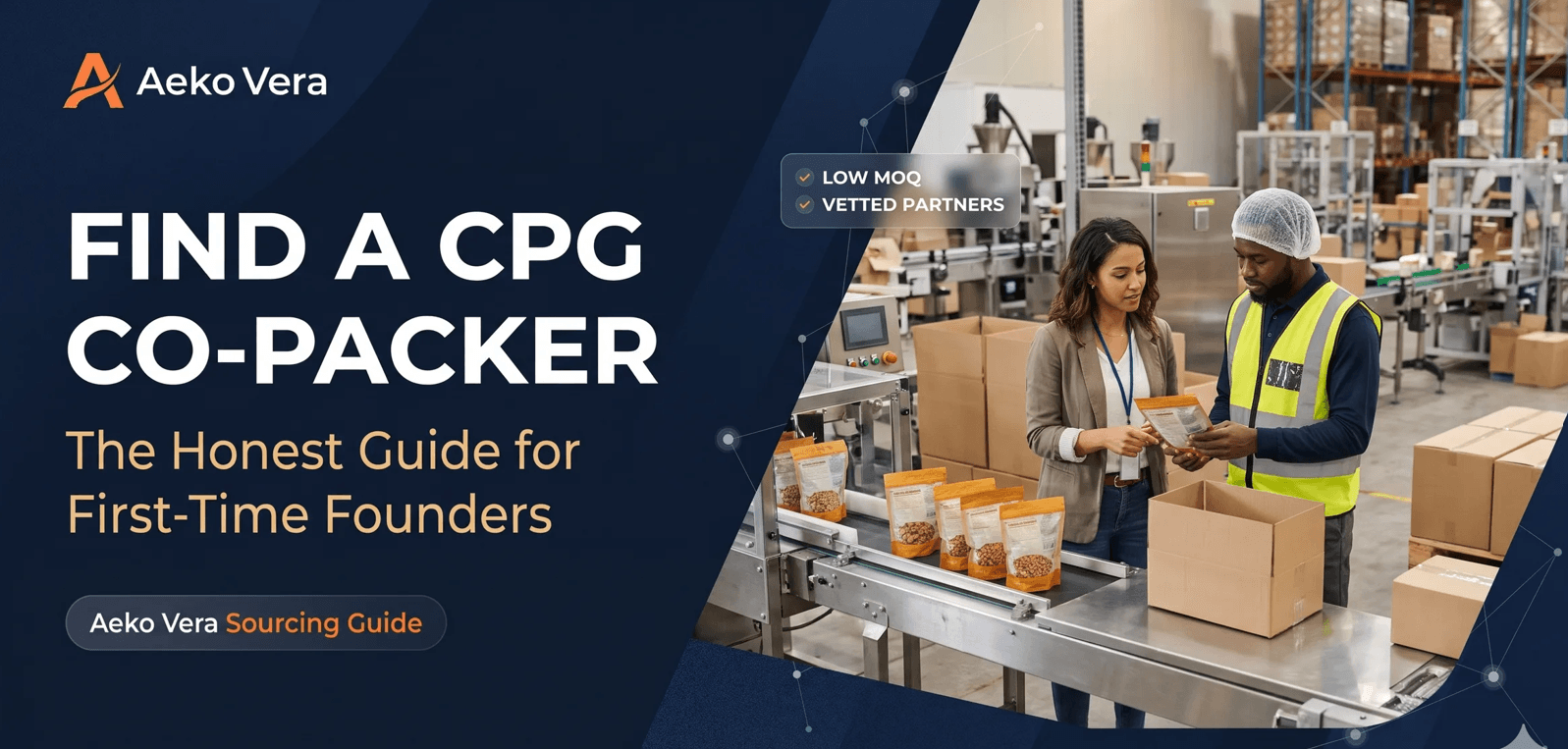
As a first-time founder, you send a spec sheet to five co-packers and hear back from one, three weeks later, quoting a 25,000-unit minimum for a brand with four retail doors. Sometimes, after 11 weeks into a conversation with a CPG co-packer, you don't know if they're interested.
If you're trying to find a CPG co-packer, these have become the default experience for a founder with 2,000 units of ambition and no co-manufacturing agreement template, no plant-tour checklist, and no idea what a reasonable quote looks like. In this blog, I'll break down what co-packers actually do, whether you're ready for one, what they'll expect from you, what it costs, how to vet them, where to find reliable CPG co-packers, and what happens after you sign.
Key Takeaways
- What is a CPG co-packer? A third-party manufacturing partner that produces, fills, and packages your product under your brand name, operating either as a toller (using your ingredients) or a turnkey co-manufacturer.
- What do I need before contacting a co-packer? A locked, shelf-tested recipe, compliant labeling (such as Supplement Facts and 21 CFR 111 cGMP), and sufficient capital to cover your first production run plus a 60–120 day working-capital gap.
- What are typical first-run MOQs? MOQs range from 500–3,000 units for small-batch specialty sauces and foods to 10,000–50,000+ units for industrial beverage lines.
- How much cash do I need for a first run? Upfront cash exposure typically spans from $20,000 for a small bottled pilot up to $350,000+ for large industrial runs, usually requiring a 30–50% deposit or 100% prepay for new brands.
- How long does the entire launch process take? From your initial discovery call to having the first pallet on your loading dock, the timeline typically takes 16 to 28 weeks.
What Can a Co-Packer Do for Your Business?
A CPG co-packer — short for contract packager, often used interchangeably with co-manufacturer or co-man — is a third-party facility that produces, fills, or packages your product to your spec, under your brand. In practice, the services run on a spectrum:
- Pure co-packing (tolling model): You supply the formulated product and the packaging. The co-packer fills, seals, labels, and cases it. Common for beverage brands shipping finished syrup to a canning line, or supplement founders shipping bulk powder for stick-pack filling.
- Co-manufacturing (turnkey model): The CPG co-manufacturer sources ingredients, manufactures the product from your formula, and packages it. Most first-time founders need this.
- Formulation plus co-manufacturing: A smaller set of co-packers will help you refine or lock the formula, usually for a fee of $5,000–$25,000+. Watch the IP clauses — some retain partial rights to the recipe they develop.
- Specialty capabilities:
- HPP (high-pressure processing) — uses high pressure instead of heat to extend shelf life for cold-pressed juice, hummus, salsas, and ready meals.
- Aseptic filling — sterile fill-and-seal for shelf-stable dairy alternatives, premium juices, and plant-based milks that don't need refrigeration.
- Retort — pressurized heating of sealed packages for shelf-stable soups, sauces, pet food, and ready meals.
- cGMP-certified lines — current Good Manufacturing Practice facilities required to legally manufacture dietary supplements under 21 CFR 111.
For most emerging CPG brands, the real reason to find a CPG co-packer isn't to save money. It's to buy access to equipment, certifications, and consistent output you can't replicate yourself. Co-packers also unlock your CPG supplier network — approved packaging partners, ingredient brokers, and logistics providers already vetted on their lines, which saves weeks of your own sourcing.
Are You Ready to Work with a Co-Packer?
Co-packers want brands that have their act together. Here are three questions worth answering honestly before you make the first call to find a co-packer:
Is your formula finalized and shelf-tested?
You need a locked recipe with ingredient specs, process steps, pH or water-activity values where relevant, and a shelf-life study if you're going shelf-stable. A CPG co-packer won't develop your product for you unless you pay them to — and if they do, you give up IP leverage. Finish the recipe in a shared commercial kitchen, a culinary incubator, or with an independent formulation lab first.
Is your labeling compliant?
For food, that's a compliant Nutrition Facts panel (or Supplement Facts for dietary supplements), ingredient declaration in descending weight order, allergen statement, net weight, and manufacturer identity. For supplements, 21 CFR 111 cGMP applies. If any of this is "I'll figure it out," you're not ready to run a production batch.
Can you cover the first run plus the working-capital gap?
CPG co-manufacturers typically ask for a 30–50% deposit at booking, with the balance due at or near shipment. First production runs often require 100% prepay because you have no track record. Then your retailer pays you Net 60 to Net 120. That gap — paying the co-packer in month 1, getting paid by the retailer in month 3 or 4 — is the single most-underestimated line item for first-time founders. For a shelf-stable snack doing 5,000 units at ~$3 landed, plan on $15,000–$20,000 out before any revenue returns.
If your answer is "not yet" for any of the above questions, get yourself ready first. You may need a shared kitchen to finish the recipe, a regulatory consultant to lock the label, or a revenue-based lender or inventory line of credit to bridge Net 60–120. Then you can start looking for your co-packer once you are ready.
What Will a Co-Packer Expect from You?
Walking into a first conversation, meet your CPG co-manufacturer with clarity on the following aspects:
- Product spec sheet — formulation, ingredients, process steps, finished-product specs (pH, Brix, viscosity, moisture, Aw as applicable).
- Packaging spec — bottle/jar/pouch dimensions and material, closure type, label artwork with dieline, carton configuration.
- Volume plan — your 12-month and 24-month realistic projections by SKU, by month, by region. Co-packers quote and schedule based on these.
- Target MOQ and cadence — how many units for the first run, how often you'll produce after.
- Retailer commitments and launch window — who you're shipping to, when, and under what compliance standard (SQF, BRCGS, Walmart supplier program, Whole Foods Quality Standards).
- Allergen and dietary claims — gluten-free, non-GMO, organic, vegan — each is an audit and a line-cleaning cost.
- Insurance — $2M+ product liability baseline, with your brand named as additional insured.
Minimum Order Quantities (MOQs) by Product Category
MOQ is the single most-asked, least-honestly-published number in CPG sourcing. These are indicative first-run ranges. Based on our industry observations, small-batch specialty CPG co-packers go lower at a premium; large industrial co-mans go higher.
| Category & format | Typical first-run MOQ | What narrows or expands it |
|---|---|---|
| Sauce / condiment (jars) | 500 – 3,000 jars | Specialty small-batch; higher unit cost |
| Bottled still beverage (PET / glass) | 1,000 – 3,000 cases | Small co-packer with semi-manual line |
| Small-batch canned beverage (sleeved) | 2,500 – 10,000 cans | Sleeved cans skip the ~180,000-can printed-can minimum |
| Beverage (industrial co-pack) | 10,000 – 50,000 units per SKU | Where most beverage co-packers land |
| Shelf-stable snack (bar, extruded) | 1,500 – 5,000 units | Depends on wrapper format |
| Supplement — stick-pack / sachet | 5,000 – 100,000+ units | Powder blends sit at the high end |
| General food (shelf-stable) | 5,000 – 15,000 units per SKU | Depends on line setup and changeover |
Source: Aekovera's vetted supplier network analysis, 2026.
Low MOQ CPG co-manufacturers charge a 20–50% unit-cost premium at the smallest volumes — often the right trade-off for a first run because it lets you learn, iterate, and move volume to a larger co-man later without blowing capital.
Format drives MOQ as much as category does. Sleeved cans vs. printed cans, PET vs. glass, powder vs. capsule, pouch vs. carton — each has its own floor. Ask about format first.
How Much Does It Cost to Work with a Co-Packer?
Co-packer cost comes in four buckets.
First-run cash exposure
| Run type | First-run cash | Deposit expectation |
|---|---|---|
| Bottled pilot, ~2,000 cases | $20,000 – $50,000 | 30–50% at booking; often 100% prepay for new brands |
| Shelf-stable, ~50,000 units | $80,000 – $150,000 | 30–50% at booking |
| Industrial printed-can run, 180,000+ cans | $150,000 – $350,000 | Usually 100% prepay |
Source: Aekovera's vetted supplier network analysis, 2026.
Per-unit quote
Check the pricing on paper: ingredient cost, packaging, labor, line time, overhead, and margin. Ask for pricing at three volumes — the MOQ, your realistic 12-month run rate, and the volume that would place you in regional retail — because the per-unit cost falls hard as volume rises.
Setup, changeover, and tooling fees
Initial setup costs typically run $2,000–$4,000 for a straightforward shelf-stable line. Dedicated tooling (custom bottle neck, custom cap, aseptic changeover) can push this to $10,000–$50,000. If a CPG co-packer owns the tooling, make sure the contract says you can take it with you.
Hidden costs
Hidden costs can quickly increase if you aren't careful. Ask explicitly:
- Inbound freight to the facility, outbound freight from the facility (per 500 miles adds roughly $0.03–$0.08 per unit).
- Ingredient waste bands (industry baseline is free below 2.5% waste, split 50/50 from 2.5–4%, co-packer absorbs above 4%).
- Rush fees (1.3–1.5× standard).
- Storage grace (usually 10 business days before storage fees start).
- Annual escalators (cap these at 3–4% tied to PPI or CPI).
Hidden costs can take a $2.75 quoted unit to $3.73 landed — a 36% premium if you don't negotiate them.
Working-capital trap
Managing working capital can be challenging for first-time founders. You pay the co-packer at or near production. Your retailer pays you Net 60 to Net 120. For 60 to 120 days you're carrying the full cost of goods out of your own capital. Factor it in, finance it, or shrink the first run.
In most new-brand contracts, the brand carries ingredient cost for a batch that fails for your reasons (an off-spec ingredient you supplied, a label you approved); the co-packer carries labor and overhead if the fault is theirs. Get specifics in writing — split percentages, dispute process, whether a redo is included or billed.
How to Vet a CPG Co-Packer Before Signing a Contract
Use this 10-point checklist to vet a CPG co-packer:
- GFSI-benchmarked certification. SQF, BRCGS, FSSC 22000, or IFS. Ask for the current certificate, edition number, scope, and most recent audit score with corrective actions closed. SQF Edition 10 was published March 2026 but Edition 9 remains the audit basis until the transition completes around January 2027 — don't let anyone tell you Ed. 10 is already enforced.
- FDA registration and FSMA compliance. Current FDA Food Facility Registration under 21 CFR 1 Subpart H (renewed biennially; the 2026 renewal window is October 1–December 31). PCQI (Preventive Controls Qualified Individual) on staff. FSMA 204 traceability plan if your product is on the Food Traceability List (compliance date July 20, 2028).
- Category experience. Not just "we do beverages" but "we run 2,500-case bottled kombucha pilots on a hot-fill line like yours." Ask for three references in your category and call them.
- Equipment and format match. Can they run your exact pouch, cap, bottle neck, cold-fill vs. hot-fill, or stick-pack width?
- Ingredient sourcing. Who sources — you or them? What's on their approved supplier list? Can you add yours?
- Quality systems. Written SOPs, allergen control program, HACCP plan, retention sample policy, lot-level traceability, documented mock-recall drill in the last 12 months.
- Communication cadence. Who's your point of contact, how fast do they respond, and is the quality manager independent of sales? (If QA reports to the sales lead, keep shopping.)
- Insurance and recall coverage. General liability $2M/$5M, product liability $5M, recall coverage $2M. Request a Certificate of Insurance naming your brand as additional insured.
- Location and logistics. Freight-in and freight-out costs; proximity to your retailer DCs; climate-controlled storage.
- Facility visit under NDA. Non-negotiable. On-site, look for: clean sanitation records, visible SOPs, consistent GMP behavior (hairnets, gloves, no jewelry on the floor), allergen zones, orderly ingredient storage, and permission to walk the production floor during a run.
Red Flags in Co-Packers to Watch Out For
- Quote arrives before you've shared a full spec sheet. (Price-only sales motion.)
- Quality manager also sells to brands.
- Suspiciously low MOQ with no explanation of how.
- 100% prepay with no failed-batch clause.
- Multi-year exclusive required before a trial run.
- Won't share FDA facility registration number.
- Won't let you visit the plant before signing.
- No written co-manufacturing agreement template — they expect you to supply one.
- Vague certification status ("we're working toward SQF").
Where Can You Find a CPG Co-Packer?
There's no single authoritative directory of CPG co-packers, which is part of what makes this hard. Five realistic channels, each with trade-offs:
- Sourcing platforms. Fastest path for a first-time founder is marketplaces because the platform screens for capability match. Trade-off: platforms vary in how deeply they vet listings — ask about match criteria and audit cadence.
- Certification body databases. The SQFI, BRCGS, and FSSC 22000 public registries let you filter certified facilities by product category and geography. Everyone listed is already GFSI-benchmarked, which eliminates a vetting step. Trade-off: slower; you still need to cold-reach.
- Trade shows. Expo West (natural products), Expo East, SupplySide West (supplements and beauty), PACK EXPO (packaging), NRA (foodservice). Walking the exhibitor floor with a one-page product sheet is the highest-density co-packer discovery you can do in three days.
- Industry trade groups. The Contract Packaging Association (CPA) member directory, PMMI member directory, and the Flexible Packaging Association for pouches. Member listings tend to skew mid-to-large, which is useful once you've outgrown low-MOQ CPG co-manufacturers.
- Founder referrals and incubators. SKU, Food-X, Chobani Incubator, Techstars Farm to Fork, Beam, Launchpad. Referrals through an accelerator carry the highest signal because the incubator stakes its reputation on the match.
The founders who get to market fastest usually run two of these channels in parallel — most often a marketplace plus incubator referrals, or a marketplace plus a trade-show pass if the category is specialty (functional beverage, high-dose supplement, aerosol personal care). Build a shortlist of 5–7 CPG co-packers, run the first-call screen against each, and narrow to 2–3 for facility visits.
What Happens After You Find the Right Co-Packer?
Signing the agreement is a milestone, not the finish line. A realistic timeline from first conversation to first pallet on dock is 16 to 28 weeks, longer for cGMP supplements, allergen-controlled lines, or seasonal co-packer book-out.
| Stage | Typical duration |
|---|---|
| Discovery & shortlist (5–7 CPG co-packers) | 2 – 4 weeks |
| NDA, formula transfer, quote, facility visit | 4 – 8 weeks |
| Co-manufacturing agreement + first PO | 2 – 4 weeks |
| Ingredient and packaging sourcing (parallel) | 6 – 12 weeks |
| Pilot batch, QA sign-off, first production run | 8 – 12 weeks |
Source: Aekovera onboarding benchmarks, 2026. First-time founder, straightforward shelf-stable or beverage product.
The first production run
Your first production run usually includes a pilot batch — a small-volume trial on a representative line, 10–20 units of first-article inspection, Statistical Process Control checks every 15–30 minutes, and six retention samples per lot held for shelf life plus six months. Expect to be on-site for your first run; most CPG co-packers welcome the brand founder in the plant that day.
Quarterly Business Reviews
Once you're in production, set a QBR cadence from day one. Co-packers run multiple customers on shared lines, and attention goes to the brands with the clearest forecasts and the fewest surprises. A disciplined QBR is how you become one of those brands — which translates into priority scheduling when a retailer window tightens, faster issue resolution when a batch runs off-spec, and real negotiating leverage at your next contract cycle.
Metrics worth tracking together with your co-packer:
- On-time delivery: ≥95%
- Rejection rate: ≤1.5% for food, ≤0.8% for non-food
- Waste: ≤3%
- Cost variance: ≤5% against quoted pricing
- Your forecast accuracy: ≥80%
Dual-sourcing
Once you cross $15M in revenue or 30+ SKUs, start a second qualified CPG co-packer running an 80/20 split. The qualification cycle takes 4–6 months, so start it before you need it.
Switching co-packers
Switching co-packers happens, often twice in the first three years. Your contract should include a reasonable termination clause (30–90 days' notice), a formula hand-back provision (your IP is yours in writing), and a transition-help clause (usually 60 days). The practical cost of switching is 8–16 weeks and you also have to factor in the capital for a new onboarding.
How Aekovera Helps You Find the Right Co-Packer
Aekovera is an AI-powered sourcing platform built specifically for first-time and emerging CPG brands. Instead of cold-emailing certification databases or filtering through generic directories, you describe your product, format, volume, and compliance needs in simple English. Aekovera's AI platform matches you against a vetted CPG supplier network of co-packers, co-manufacturers, and CPG packaging partners that already have the certifications, capacity, and category experience your spec requires.
Every co-packer on Aekovera has been pre-screened for GFSI certification status, FDA registration, and category experience. Our platform surfaces real MOQ bands up front — so you don't spend three weeks on a call with a co-packer whose floor is three times your plan. For founders in the 500–5,000 unit ambition tier, Aekovera prioritizes low-MOQ CPG co-manufacturers and specialty small-batch facilities that still meet retailer certification requirements.
Capability matching is free. You get a shortlist of 3–5 pre-qualified co-packers in your category, with their MOQ ranges, certifications, and lead-time windows visible before the first call. Start a free capability-matched supplier search on Aekovera today to find your co-packer.
About the author. I'm Dr. Kritika Jha, Head of Supplier Research at Aekovera. I've spent the last several years helping first-time CPG founders find and vet co-manufacturers across food, beverage, and dietary supplements. At Aekovera I build the capability-matching logic that pairs founders with pre-qualified co-packers, and I write about the operational decisions behind every production run. More about me.